Free sample from Health Before Modern Medicine by Hadi Ataei.
“Eat and drink, but be not excessive. Indeed, He likes not those who commit excess.” Qur’an 7:31
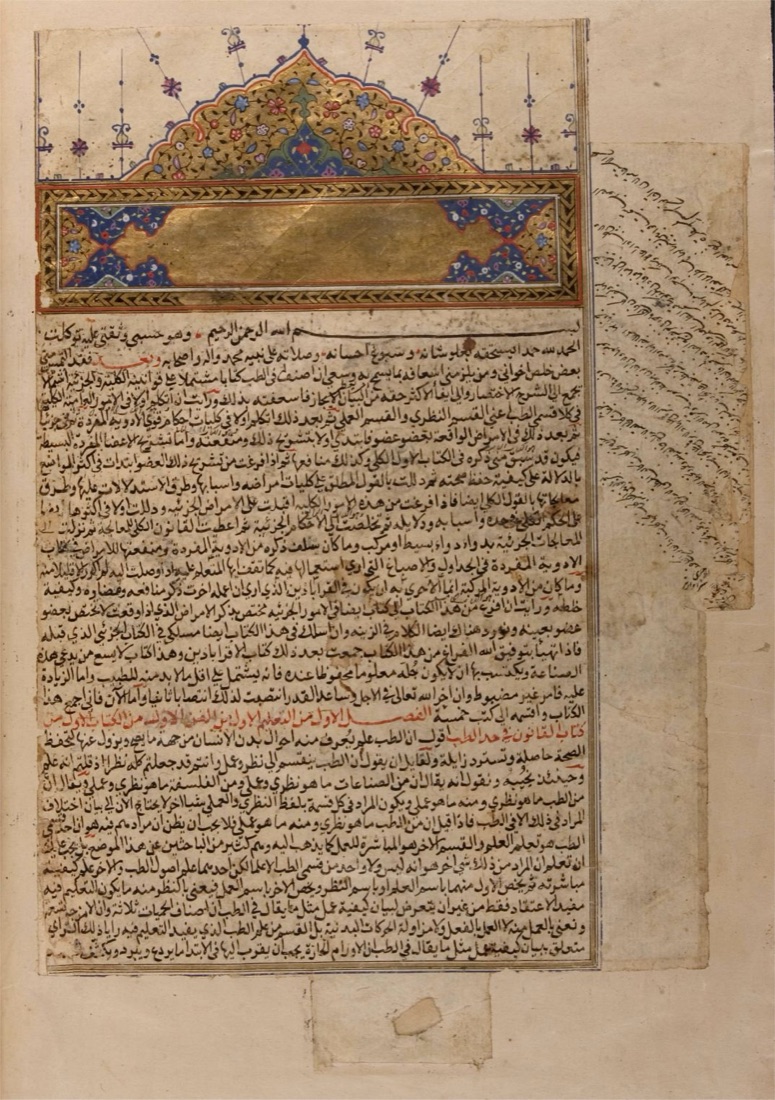
The opening page of a 16th-century manuscript of Ibn Sina’s Canon of Medicine. Yale University Library, via Wikimedia Commons (public domain).
A different question
Imagine two people with the same headache.
One goes to a modern clinic. The doctor asks what the symptom is and what will stop it. If the cause is an infection, a fracture or a failing heart, this approach is extraordinary. It has saved more lives in the last century than the whole of history before it.
The other goes to a physician in Baghdad, a thousand years ago. This physician asks a wider question: what is happening in this person’s body as a whole that allows the headache to appear? How do they eat? When do they sleep? How is their digestion? What is the season, and what has the week been like?
This book is about that second question. It is not an argument against modern medicine. It is an invitation to recover a way of looking after yourself that Muslims, and many peoples of West Asia before them, practiced for centuries: look after the daily things first, so that medicine is needed less often.
The Arabic word for this tradition is Tibb (طب), which simply means medicine. Where the word is qualified, you will see al-tibb al-nabawi, prophetic medicine, which is a separate literature that this book does not draw on. We stay with the Qur’an and the classical physicians, whose writings we can read and check.
Where Tibb came from
Tibb did not appear from nowhere, and it was never only “Arab” or only “Islamic.” It grew where several traditions met.
Greek medicine, especially the writings attributed to Hippocrates and Galen, had been preserved in Syriac and then translated into Arabic. Persian physicians brought the medical schools of the Sasanian world, such as the one reported at Gundeshapur. Indian texts on medicine and pharmacology were also translated. Historians debate how large a role Gundeshapur played, and the details of the translation movement are covered in the histories listed at the end of this book.
From the eighth to the tenth century, scholars in Baghdad and elsewhere translated, compared and corrected these sources. Hunayn ibn Ishaq, a physician and translator, is remembered as one of the most important figures of this work. The result was not a copy. Physicians tested the old ideas against what they saw in patients, wrote case notes, and argued with their predecessors openly.
The word “West Asia” in the title is deliberate. The physicians in this book lived and worked from Persia and Central Asia, through Iraq and the Persian Gulf region, to Syria, Egypt and Andalusia. Their world was one of shared languages of learning and constant travel. It is a more accurate and more generous map than “the Arab world” or “the Middle East.”
The people you will meet
You will meet a handful of physicians repeatedly in this book. A short introduction now will help.
- Al-Razi (known in Latin as Rhazes, died about 925). A Persian physician and philosopher, remembered for clinical observation and for his writings on diet, smallpox and measles. He is reported to have advised treating with diet first and drugs only if diet fails.
- Ibn Sina (known in Latin as Avicenna, died 1037). Another Persian physician, whose Canon of Medicine became one of the most widely read medical texts in history, used in Europe and the Islamic world for centuries. His discussion of health in the Canon opens with the daily essentials of life, and we will build much of this book on it.
- Al-Zahrawi (Abulcasis, died about 1013). An Andalusian surgeon whose illustrated surgical writings were widely copied.
- Ibn al-Nafis (died 1288). A physician in Damascus and Cairo, remembered for describing the passage of blood through the lungs.
We will quote them with care. Where a saying is reported but we cannot confirm the source, we will say so.
The hospital and the home
Tibb was not only books. In many Islamic cities there were hospitals, called bimaristan (from the Persian for “house of the sick”). They treated patients regardless of religion and wealth, trained physicians and kept records. Well-known examples stood in Baghdad, Damascus and Cairo.
But most health was kept at home, through habit. That is the part of the tradition that matters most for us. The physicians wrote regimens: how to eat, how to wake, how to move, how to live in each season. A regimen was a set of daily choices, repeated until it became character.
The idea that holds it together: balance
If one idea runs through all of Tibb, it is balance. The body was understood to have a natural state, and illness was seen as a drift away from it. Food, movement, sleep, season, emotion and the surrounding air could each push the body one way or the other. The physician’s task was to restore balance, first with the gentlest tools: diet and routine.
The Qur’an supports this attitude in its repeated call for moderation. Besides the verse that opens this chapter, there is the command to eat of the good things provided without transgressing (Qur’an 20:81). Whatever else we say about classical medicine, its preference for moderation and for prevention is one of its strongest and most durable ideas.
What Tibb got right, and what it did not
A fair book must say both.
The classical framework explained health through humors, four fluids that were thought to govern the body, and through temperament. Modern science does not use this theory, and you should not use it to diagnose yourself. We will explain it in Chapter 4 as history and as a way of thinking, with its limits stated clearly.
Yet much of the practical advice that sat on top of the theory is now supported by modern research or is at least consistent with it:
- Moderation in eating, and stopping before you are full.
- Regular physical activity, in sensible amounts.
- Enough sleep, at regular times.
- Attention to digestion, hydration and the quality of the food you eat.
- Calm and emotional steadiness as part of health.
The Global Burden of Disease study, for instance, estimated that dietary risks were behind 11 million deaths in 2017. [Lancet 2019, PubMed 30954305] The WHO describes a healthy diet as protection against diabetes, heart disease, stroke and cancer. [WHO, Healthy diet]
Other parts of the tradition, such as cupping and certain remedies, have a thinner or mixed evidence base. We will treat each honestly in its own chapter. Where evidence is weak, we will say “traditionally used,” not “proven.”
What this book is, and is not
This book is written for any reader curious about traditional medicine, and for Muslims reconnecting with their own heritage in particular. You do not need to share the faith to use it. The Qur’an verses at the head of each chapter are part of the sources, and we quote them as such. This is a practical guide. By the end, you should have a way to arrange your day, food, movement, sleep and fasting that is rooted in this heritage and consistent with modern evidence.
It is not a substitute for a doctor. If you are ill, pregnant, on medication or managing a chronic condition, a physician must guide you. Tibb at its best would say the same: the classical physicians insisted on consulting someone qualified, and so should you.
A note on how we work
Every health claim in this book either has a reference you can check or is clearly labeled as traditional or reported. Where we are not sure, we say so. If you find an error, please tell us, so we can correct it in the next edition.
In this chapter
- Tibb is a medical tradition that grew where Greek, Persian, Indian and Arabic learning met, and was refined by physicians who tested it on patients.
- Its core idea is balance, and its first tools are food and daily routine.
- The theory (the humors) is historical. Much of the practical advice is consistent with modern prevention.
- This book uses the Qur’an and the classical physicians only, states its limits, and is not medical advice.
Reflection
Look at your own day. Which of the daily essentials (what you eat, how you move, when you sleep) is furthest from balance right now? Choose one and keep it in mind as we go through the next chapters.
Keep reading
Chapter 1 is the free sample. The rest of the book covers the great physicians, the six essentials, food and water, movement, sleep, fasting in Ramadan, and cupping and leech therapy.
Medical disclaimer
This book is guidance and education only. It is not medical advice and the author is not a physician. Consult your physician before changing your diet, exercise, fasting or any treatment.